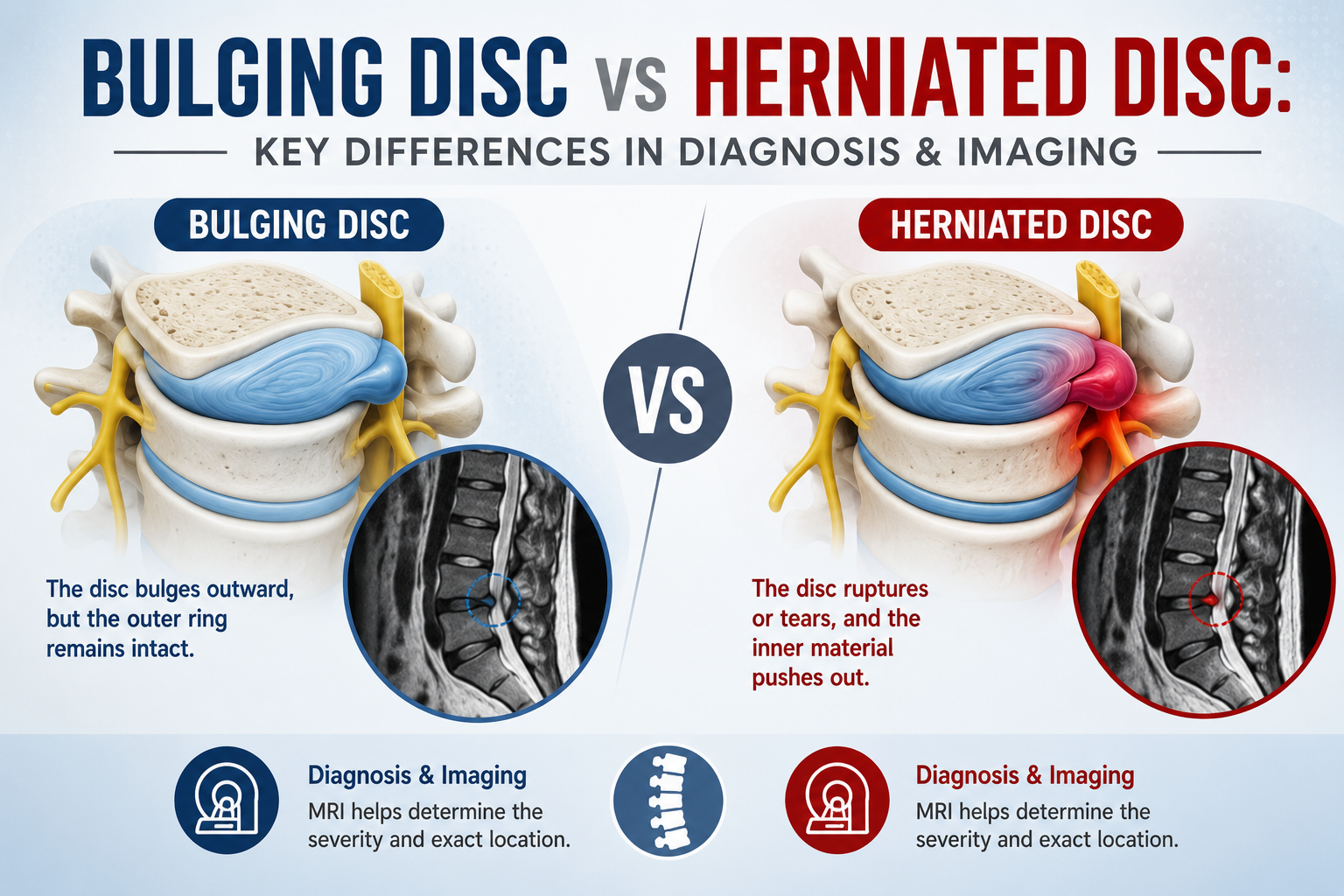
Bulging Disc vs Herniated Disc: Key Differences in Diagnosis & Imaging
When back or neck pain begins interfering with daily activities, one of the most common questions patients ask is whether they are dealing with a bulging disc vs herniated disc. Although these spinal conditions are often discussed together, they are not the same. Understanding the distinction is critical because the diagnosis, treatment recommendations and long-term outlook may vary depending on the specific condition.
A spinal disc acts as a cushion between vertebrae, helping absorb shock and support movement. Over time, age-related degeneration, repetitive strain, injury or poor posture can affect these discs, leading to abnormalities that may cause pain, numbness, weakness or reduced mobility. However, distinguishing a bulging disc vs herniated disc requires more than symptom assessment alone. Accurate disc diagnosis typically involves a combination of clinical evaluation and advanced imaging studies.
Many patients are surprised to learn that some disc abnormalities may appear on imaging even when symptoms are absent. This makes proper interpretation of MRI and CT findings essential for accurate treatment planning.
In this guide, we will explore the differences between a bulging disc and a herniated disc, discuss common symptoms, review diagnostic procedures, examine imaging findings and explain how healthcare providers determine the most appropriate treatment approach.
Understanding Bulging Disc vs Herniated Disc
What Is a Bulging Disc?
A bulging disc occurs when the outer layer of the spinal disc extends beyond its normal boundary. The disc remains intact, but it protrudes outward, often affecting a broad portion of the disc circumference.
Bulging discs commonly develop due to:
- Age-related disc degeneration
- Repetitive spinal stress
- Poor posture
- Occupational strain
- Gradual wear and tear
Many people with a bulging disc experience no symptoms. However, symptoms may occur if the disc begins pressing against nearby nerves.
Key Characteristics of a Bulging Disc
- Disc wall remains intact
- Broad-based protrusion
- Often develops gradually
- Frequently associated with aging
- May be asymptomatic
What Is a Herniated Disc?
A herniated disc occurs when the inner gel-like material of the disc pushes through a tear or weakness in the outer disc layer.
Unlike a bulging disc, a herniated disc involves disruption of the disc structure. This often increases the likelihood of nerve irritation and symptom development.
Common causes include:
- Sudden lifting injuries
- Traumatic accidents
- Degenerative changes
- Repetitive bending and twisting
Key Characteristics of a Herniated Disc
- Outer disc layer is damaged
- Inner material extends outward
- Often causes nerve compression
- Symptoms may appear suddenly
- Higher risk of neurological issues
Bulging Disc vs Herniated Disc Symptoms
Shared Symptoms
One reason patients often confuse bulging disc vs herniated disc conditions is because symptoms can overlap significantly.
Common symptoms include:
- Back pain
- Neck pain
- Radiating pain
- Muscle weakness
- Numbness
- Tingling sensations
The severity of symptoms often depends more on nerve involvement than the size of the disc abnormality itself.
Symptoms More Common with Herniation
A herniated disc is generally more likely to compress spinal nerves and produce noticeable symptoms.
Potential symptoms include:
- Sciatica
- Arm pain
- Foot weakness
- Hand weakness
- Burning sensations
- Reduced reflexes
Red Flags Requiring Immediate Evaluation
Seek prompt medical assessment if symptoms include:
- Loss of bowel control
- Loss of bladder control
- Progressive weakness
- Difficulty walking
- Saddle anaesthesia
These symptoms may indicate serious neurological involvement requiring urgent intervention.
The Role of Disc Diagnosis in Treatment Planning
Why Accurate Disc Diagnosis Matters?
Effective treatment begins with a thorough disc diagnosis process. Symptoms alone cannot reliably distinguish a bulging disc from a herniated disc.
Healthcare providers evaluate:
- Medical history
- Symptom duration
- Pain location
- Neurological findings
- Functional limitations
A comprehensive evaluation helps ensure imaging findings align with clinical symptoms.
Physical Examination Components
During the examination, providers may assess:
- Muscle strength
- Reflexes
- Sensory function
- Range of motion
- Walking ability
These findings contribute significantly to accurate disc diagnosis and treatment planning.
Diagnostic Challenges
Not every imaging abnormality causes symptoms.
Research has shown that many healthy adults have disc abnormalities visible on MRI despite experiencing no pain. This highlights the importance of correlating imaging findings with clinical symptoms rather than relying solely on scan results.
MRI Findings in Bulging Disc vs Herniated Disc
Why MRI Is the Preferred Imaging Tool?
MRI remains the gold standard for evaluating spinal disc conditions because it provides detailed images of soft tissues, nerves and spinal structures.
Benefits include:
- No radiation exposure
- Excellent soft tissue visualization
- Detailed nerve assessment
- Accurate disc evaluation
MRI is often central to confirming bulging disc vs herniated disc findings.
MRI Appearance of a Bulging Disc
MRI typically shows:
- Broad, symmetrical disc extension
- Intact outer disc structure
- Mild nerve contact
- Disc degeneration changes
Radiologists evaluate the extent of protrusion and its impact on nearby structures.
MRI Appearance of a Herniated Disc
MRI findings may reveal:
- Focal disc protrusion
- Disc extrusion
- Disc sequestration
- Nerve root compression
- Inflammatory changes
These findings help guide treatment decisions and improve diagnostic accuracy.
Additional Imaging Methods for Disc Diagnosis
Computed Tomography (CT)
CT scans may be recommended when MRI is unavailable or contraindicated.
CT imaging can help assess:
- Bone structures
- Spinal alignment
- Degenerative changes
- Disc abnormalities
However, MRI generally offers superior soft tissue evaluation.
CT Myelography
In certain cases, CT myelography may provide additional information regarding nerve compression.
This technique involves:
- Contrast injection
- Spinal canal imaging
- Nerve root assessment
Healthcare providers may use it when an MRI does not offer definitive answers.
X-Rays and Their Limitations
Standard X-rays cannot directly visualize spinal discs.
Instead, they help identify:
- Spinal instability
- Fractures
- Arthritis
- Alignment abnormalities
Although X-rays can help identify some spinal issues, they are not typically used to definitively diagnose disc problems.
Treatment Considerations After Disc Diagnosis
Conservative Management Options
Most patients improve without surgery.
Common treatments include:
- Physical therapy
- Activity modification
- Anti-inflammatory medications
- Postural correction
- Exercise programs
Many cases of bulging and herniated discs improve with non-surgical care.
Interventional Procedures
If symptoms persist, providers may recommend:
- Epidural steroid injections
- Nerve blocks
- Pain management procedures
The goal of these approaches is to alleviate inflammation and improve mobility and function.
When Surgery May Be Needed
Surgery may be considered when:
- Conservative treatment fails
- Severe nerve compression exists
- Progressive neurological deficits occur
- Daily function becomes significantly impaired
Treatment recommendations should always be individualized based on symptoms, imaging findings, and overall health status.
Preventing Future Disc Problems
Lifestyle Strategies
Taking care of your spine can reduce the chances of developing disc-related conditions in the future.
Recommended habits include:
- Regular exercise
- Proper lifting techniques
- Weight management
- Core strengthening
- Ergonomic workstations
Early Intervention Matters
Prompt evaluation of persistent symptoms can improve outcomes and reduce the risk of long-term complications.
Patients experiencing ongoing back or neck pain should seek professional assessment before symptoms worsen.
Conclusion
Understanding the differences between bulging disc vs herniated disc conditions is essential for accurate diagnosis and effective treatment. While both involve spinal disc abnormalities, their structural characteristics, imaging findings and clinical implications can differ significantly. Proper disc diagnosis requires a combination of symptom evaluation, physical examination and advanced imaging techniques such as MRI.
Detecting the condition early allows healthcare providers to provide focused care that can lead to better results and fewer long-term issues. If you are experiencing persistent back pain, neck pain, numbness or weakness, schedule a professional evaluation today. Book a consultation with a spine specialist to receive an accurate diagnosis and personalized treatment plan tailored to your needs.